In my previous blog post I looked at how the English Language had come to be the modern language it is today, however, I also wanted to look into why we have words in our dialect that have come from other countries and from people’s ideas. I am fascinated by the idea, that in some cases a set of people or a single person has altered or created words have changed the English Language. In the ‘The Dictionary of Word Origins’ I found several chapters quite interesting because they highlighted key features of the English Language that have been influenced by people or a prominent feature of history. The first example I looked into was how classic Greek Mythology has influenced the English Language. Many Ancient Greek stories consisted of Gods and included lots of characters, and these characters and Gods had an impact in creating many words that exist in modern day English.
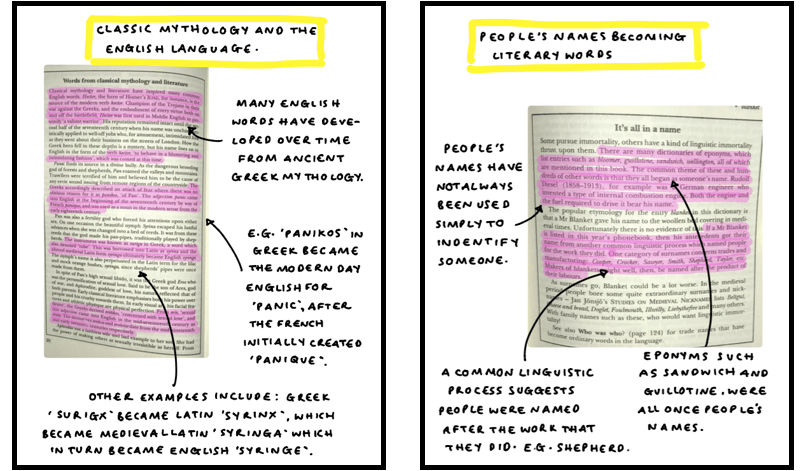
For example, the English word ‘panic’ originated from the Ancient Greek word ‘pan’. “Panic finds its source in a divine bully. As the dangerous brooding god of forests and shepherds, Pan roamed the valleys and mountains. Travellers were terrified of him and believed him to be the cause of any eerie sound issuing from remote regions of the county-side. The Greeks accordingly described an attack of fear where there was no obvious reason for it as panikos ‘of Pan’. The adjective panic came into English at the beginning of the seventeenth century by way of French panique, and was used as a noun in the modern sense from the early eighteenth century.” (Flavell.R and Flavell. L, 2004, p.20) Based on this example, it is clear to see that the development of some words happen over time, in some cases it may take more than a century for words to develop to their existing form. However, some words may be created by a single person alone in no time at all. One example of a set of words that were created by a single person are, Portmanteau Words.
 Holly's Illustrations