Speaking to Angela last yesterday got me really excited because I knew exactly what I wanted to look at next. I believe that if I am going to create a piece that is inspired by the English Language, then I will have to be well educated on the matter in order to create a well informed and convincing outcome. 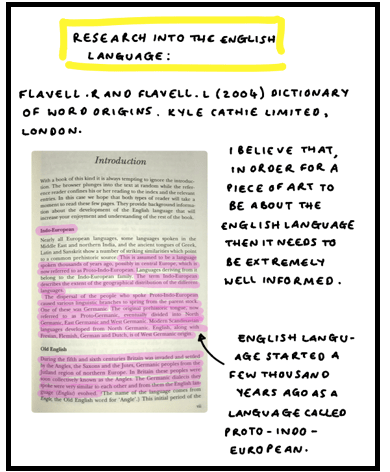
I started researching the English Language by reading a book called ‘The Dictionary of Word Origins’ by Roger and Linda Flavell. The ideas and concepts behind the origins of the words that make up the English Language are alluring. I have always understood that many words in the English Language come from a varied range of other languages throughout the world such as, French, Latin, German and Greek etc. However, I was interested to find out the origins of these languages and how they came to develop to the modern languages that they are today.
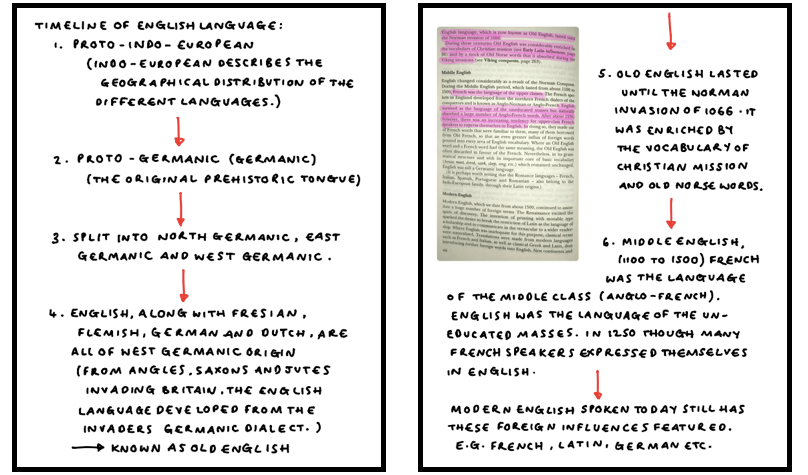
Upon reading ‘The Dictionary of Word Origins’ I created a timeline that I believe summarises the development of the English Language to that of the one we speak today. The extract featured above from my sketchbook, shows the important developmental stages that the English Language has gone through, from initially starting out as a Proto- Indo- European Language, to being divided into Territorial Languages; North Germanic, East Germanic and West Germanic. It further developed when the Anglo- Saxons and Jutes invaded Britain, bringing along their foreign languages. In turn, creating the Old English Language. Another invasion brought about a new era of the English Language, with the Norman invasion of 1066. Many changes throughout history, including invasions, class divisions and technology, have all changed the English Language as well as the way it is perceived.
After researching the development of the English Language as a whole, I wanted to take a quick look into how some English words have come into existence. They didn’t appear from nowhere, someone must have created them, right?
 Holly's Illustrations